A process is an instance of a running (or suspended) program
Threads are analogous to a “light-weight” process.
In a shared memory program, a single process may have multiple threads of control
how many threads?
in principle, there shouldn’t be more threads than there are cores (though there are situations in which it could make sense)
To check the number of cores:
$ lscpu | grep -E '^Thread|^Core|^Socket|^CPU\('
OpenMP vs Pthreads
OpenMP provides a higher abstraction interface.
On POSIX systems, it is most likely implemented on top of Pthreads (on non-POSIX systems, on top of some other threading abstraction)
= it is more portable than Pthreads (you can write the OpenMP code and run it “everywhere“ without modifying it).
Pthreads provides more fine-grained control.
(As usual, it’s a matter of trade-offs between ease-of-use and flexibility/performance)
using both
Mixing OpenMP and Pthreads in the same code should work, but there might be corner cases where it doesn’t. It is usually better to use either one or the other unless there’s a very strong reasons to mix them.
MPI and Threads
MPI_Init_thread()
To use MPI in a thread-safe manner, MPI should be initialised with an MPI_Init_thread() instead of an MPI_Init().
header
int MPI_Init_thread(int *argc, char ***argv, int required, int *provided);
required ⟶ (in) threading level (seen below)
provided ⟶ (out) supported (provided) threading level - if < than the required level, the communication might not be thread-safe
threading levels
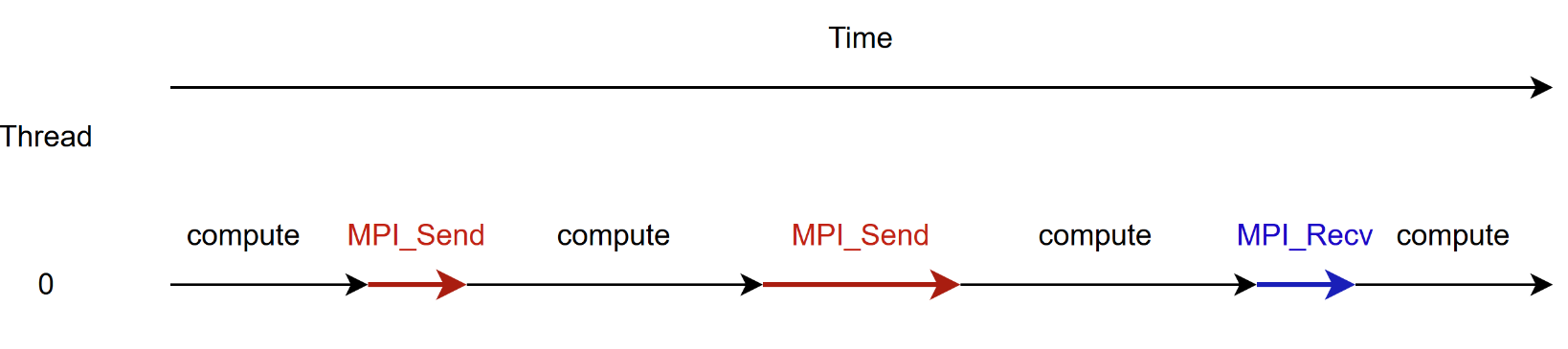
MPI_THREAD_SINGLE ⟶ caller rank is not allowed to use threads (basically equivalent to an MPI_Init)
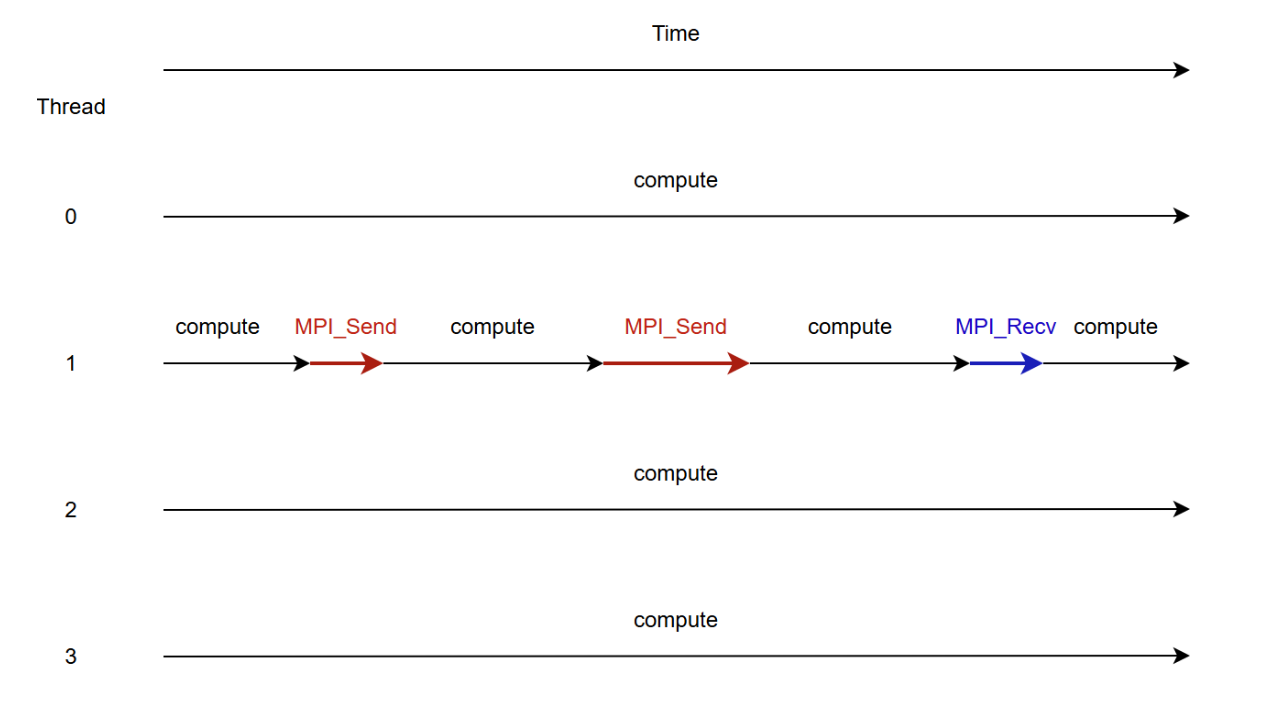
MPI_THREAD_FUNNELED ⟶ rank can be multi-threaded but only the main thread may call MPI functions
ideal for fork-join parallelism
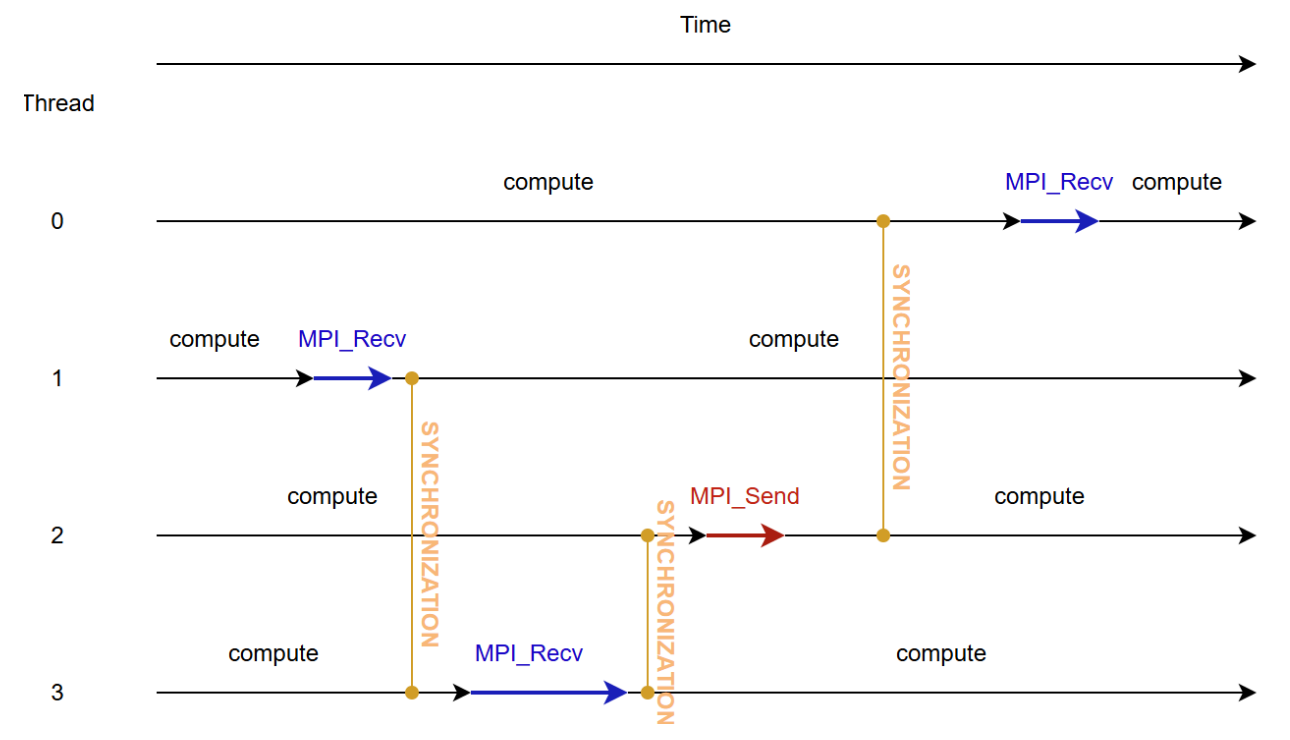
MPI_THREAD_SERIALIZED ⟶ rank can be multi-threaded but only one thread at a time may call MPI functions; the rank must ensure that MPI is used in a thread-safe way. one approach is to ensure that MPI usage is mutally excluded by all the threads
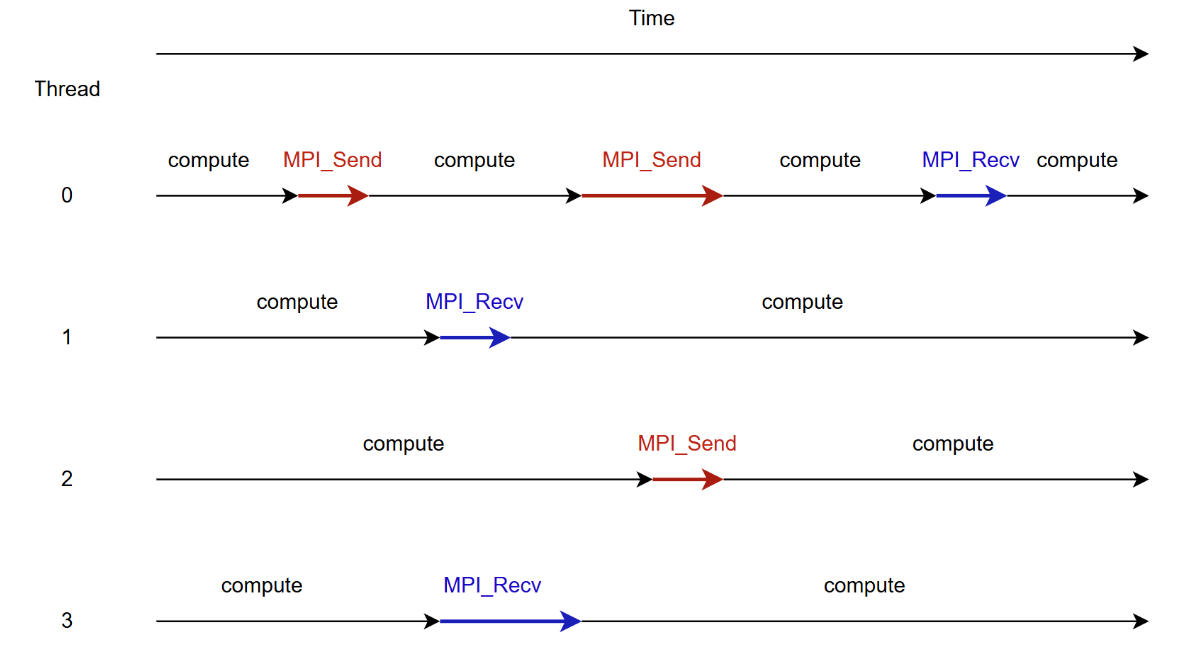
MPI_THREAD_MULTIPLE ⟶ rank can be multi-threaded and any thread may call MPI functions. the MPI library ensures that this access is safe across threads. note that this makes all MPI operations less efficient, even if only one thread makes MPI calls, so should be used only when necessary
visual representations
single:
funneled:
serialized:
multiple:
using openMP with MPI
The safest threading level for using openMP with MPI is MPI_THREAD_FUNNELED, as it fits nicely with most OpenMP models.
MPI maps each process on a core - all the threads created by that process will run on the same core. to inhibit this functionality, the --bin-to-none clause is necessary
thread-safety, re-entrant functions
A block of code is thread-safe if it can be simultaneously executed by multiple threads without causing problems.
it is not uncommon for C libraries to not be thread-safe (ex: strtok, random, localtime…)
example, strtok
Suppose we want to use multiple threads to “tokenize” a file that consists of ordinary text. The tokens are just contiguous sequences of characters separated from the rest of the text by white-space.
We could divide the input file into lines of text and assign the lines to the threads in a round-robin fashion:
the first line goes to thread 0, second goes to thread 1 etc, and we can serialize access to the lines of input using semaphores
after a thread has read a single line of input, it can tokenize the line using the strtok function
the idea is that, in the first call, strtok caches a pointer to string, and for subsequent calls it returns successive tokens taken from the cached pointer.
thread-safety strtok caches the pointer to the input line by declaring a variable to have static storage class, which causes the value stored in this variable to persist from one call to the next.
Unfortunately, the cached string is shared, not private.
So the strtok function is not thread-safe. If multiple threads call it simultaneously, the output may not be correct.
However,
In some cases, the C standard specifies alternate versions of its functions, called “re-entrant functions”, which can be interrupted (typically during thread context-switching), and re-entered by another thread without any ill-effect.
for example, strtok_r is the re-entrant version of strtok
In principle, re-entrant = thread-safe, but, in practice, re-entrant functions are often thread-safe.