Derived datatypes are used to represent any collection of data items in memory
both the item types and their locations are stored in memory
if a function that sends data knows this information about a collection of data items, it can collect the items from memory before they are sent
and a function that receives data can distribute the items into their correct destinations in memory when they are received
naive implementation
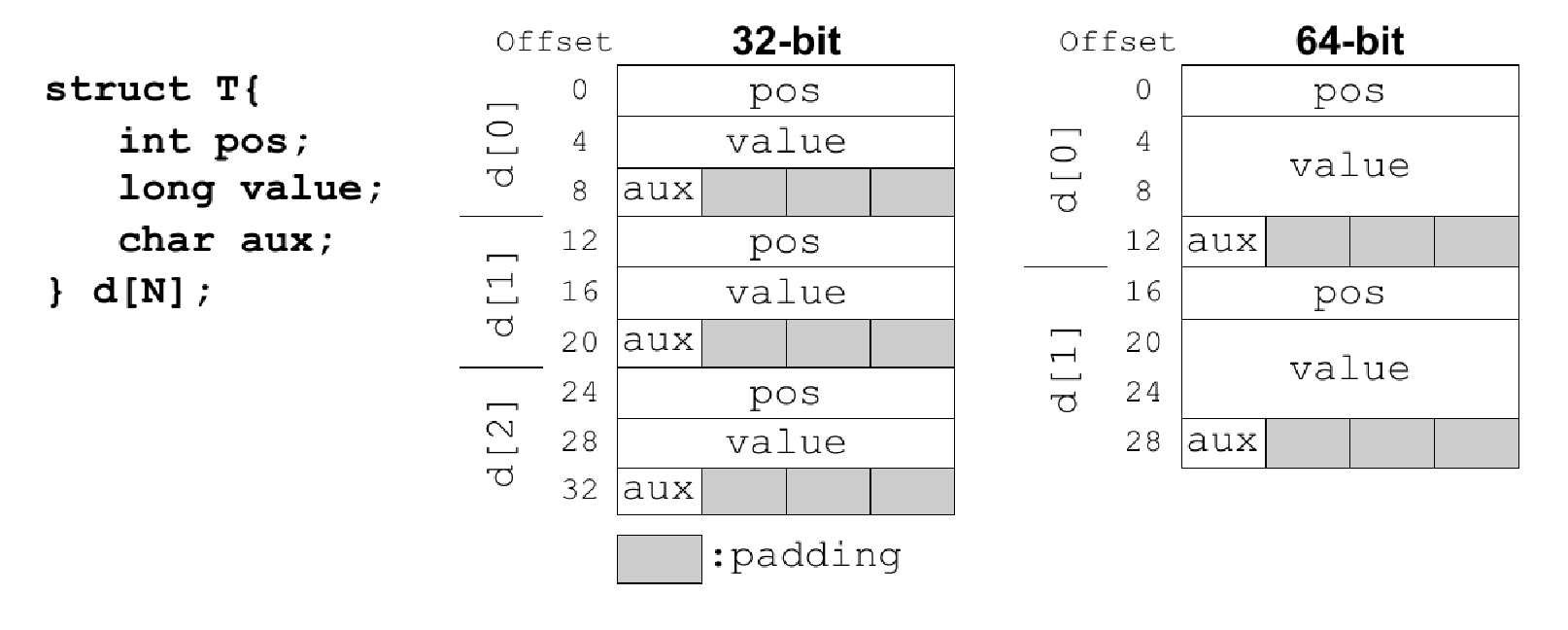
An implementation like this one wouldn’t work, because different platforms could implement a structure’s layout differently
const int N = ...;typedef struct Point{ int x; int y; int color;};Point image[N];MPI_Send(image, N*sizeof(Point), .....);
implementation
Formally, derived data types are implemented with a sequence of basic MPI data types together with a displacement for each of the datatypes.
MPI_Type_create_struct
Builds a derived datatype that consists of individual elements with different basic types.
header
int MPI_Type_create_struct( int count, // in int array_of_blocklengths[], // in MPI_Aint array_of_displacements[], // in MPI_Datatype array_of_types[], // in MPI_Datatype* new_type_p // out);
MPI_Get_address
We can’t be sure of the size of the displacements (because of the implementation) - we can use MPI_Get_address to get the address of the memory location.
header
int MPI_Get_address( void* location_p, // in MPI_Aint* address_p // out);
example
struct t { double a; double b; int n;};
MPI_Aint a_addr, b_addr, n_addr;MPI_Get_address(&a, &a_addr);array_of_displacements[0] = 0; // startMPI_Get_address(&b, &b_addr);array_of_displacements[1] = b_addr-a_addr; //first displacementMPI_Get_address(&c, &c_addr);array_of_displacements[2] = c_addr-a_addr; // second displacement (from a, not from b !!)
because & cast-expressions return a pointer, not an address.
ISO C does not require that the value of a pointer (or the pointer cast to int) be the absolute address of the object pointed at (though this is commonly the case).
Referencing may not have a unique definition on machines with a segmented address space. The use of MPI_Get_address guarantees portability.
MPI_Type_commit
Allows the MPI implementation to optimize its internal representation of the datatype for use in communication functions (it finalizes a user-defined datatype before it can be used in any communication operations)
it must be called before using the type in an operation !!
header
int MPI_Type_commit(MPI_Datatype* new_mpi_t_p); //in&out
MPI_Type_free
Frees any additional storage used for the new data type, after one is done using it.
syntax
int MPI_Type_free(MPI_Datatype* old_mpi_t_p); //in&out
other functions for new datatypes
MPI defines ~400 functions, 40 of which are used to manage datatypes.
Some other examples are:
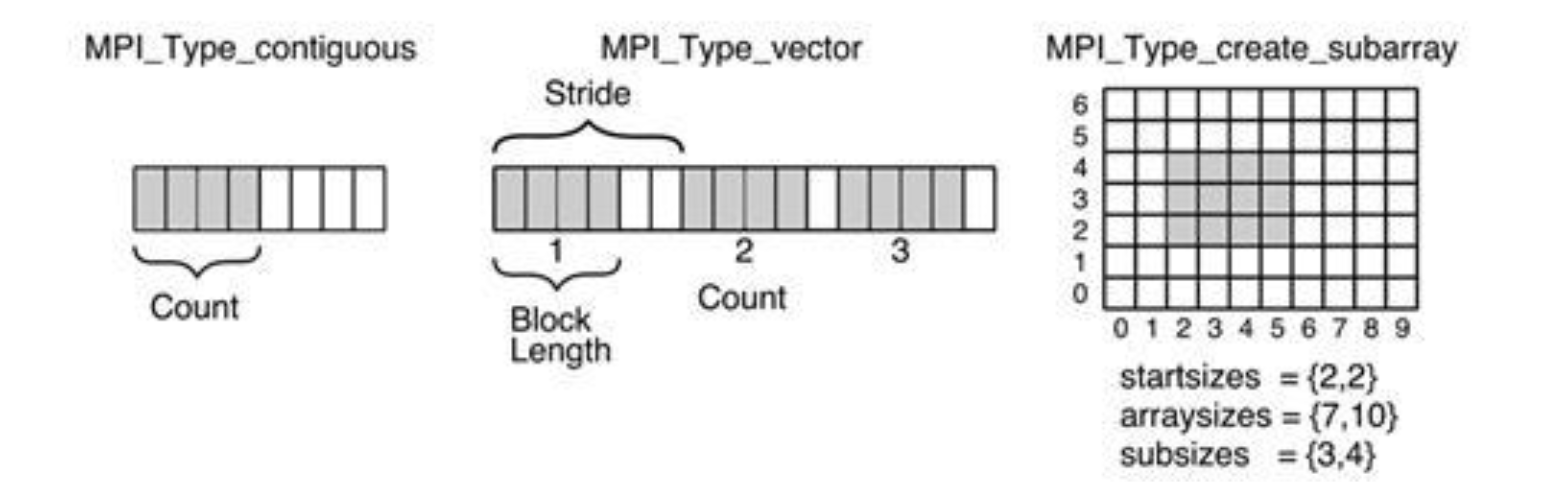
MPI_Type_contiguous:
Creates a new datatype for a single, contiguous block of elements.
MPI_Type_vector:
Creates a datatype for data elements of the same datatype that are regularly spaced (strided) in memory.
This is defined by a Count (number of blocks), a Block Length (elements per block), and a Stride (distance between the start of consecutive blocks).
MPI_Type_create_subarray:
Creates a datatype that describes a multidimensional subarray within a larger array.
Requires specifying the full array size (arraysizes), the desired subarray size (subsizes), and the starting coordinates (startsizes).
MPI_Pack / MPI_Unpack:
Used to manually pack (serialize) non-contiguous or heterogeneous data into a contiguous buffer before a send, and then unpack it on the receiving side.