There are two main categories of parallel program structure patterns:
Globally Parallel, Locally Sequential (GLPS) ⟶ the application is able to perform multiple tasks concurrently with each task running sequentially
(SPMD, MPMD, Master-Worker, Map-reduce)
Globally Sequential, Locally Parallel (GSLP) ⟶ the application executes as a sequential program, with individual parts of it running in parallel if requested
(Fork/join, Loop parallelism)
Globally Parallel, Locally Sequential (GLPS)
(the application is able to perform multiple tasks concurrently with each task running sequentially)
SPMD, MPMD
The application logic is stored in a single program.
typical program structure
program initialization
obtaining a unique identifier (numbered from 0, they enumerate the threads or processes used)
running the program - execution path changes based on ID
shutting-down the program (clean-up, saving results)
potential issues with SPMD
SPMD fails when:
memory requirements are too high for all nodes
it has to deal with heterogenous platforms
For SPMD, the execution steps are identical to SPMD, but deployment involves different programs.
both SPMD and MPMD are supported by MPI
Master-Worker
The Master-Worker model is made up of two kinds of components: Masters and Workers.
The Master (1+) is responsible for:
handing out pieces of work to workers
collecting the result of the computation from the workers
performing I/O duties on behalf of the workers
interacting with the user
The Workers do the work given by the masters.
This system is good for implicit load balancing - every time that a worker is done computing, it receives a new task until there are no more tasks available.
The master can be a bottleneck, but there can be a hierarchy of masters.
Map-Reduce
Map-Reduce is a variation of the Master-Worker pattern (made popular by Google’s search engine implementation).
The master coordinates the whole operation, while the workers run two types of tasks:
map ⟶ apply a function on data (resulting in a set of partial results)
reduce ⟶ collect the partial results and derive the complete one
Map workers and reduce workers are separate, and they can vary in number.
Master-Worker vs Map-Reduce
With the Master-Worker pattern, the same function is applied to different data items, while, with the Map-Reduce pattern, the same function can be applied to different parts of a single data item
Globally Sequentia, Locally Parallel (GLPS)
the application executes as a sequential program, with individual parts of it running in parallel if requested
Fork/Join
There is a single parent thread of execution, and children tasks are created dynamically at run-time.
tasks may run via spawning of threads, or via use of a static pool of threads
children tasks have to finish for the parent thread to continue (globally sequential)
used by OpenMP/Pthread
example
mergesort(A, lo, hi):
	if lo < hi: // |A| >= 1
		mid = [lo + (hi - lo)/2]
		fork mergesort(A, lo, mid) // process (potentially) in parallel
		mergesort(A, mid, hi) // second recursion handled by the main task
		join
		merge(A, lo, mid, hi)
Loop parallelism
Loop parallelism is employed for migration of sequential/legacy software to multicore. It focuses on breaking up loops by manipulating the loop control variable.
loops have to be in a particular form to support this
the flexibility is limited, but so is the effort
supported by OpenMP
examples
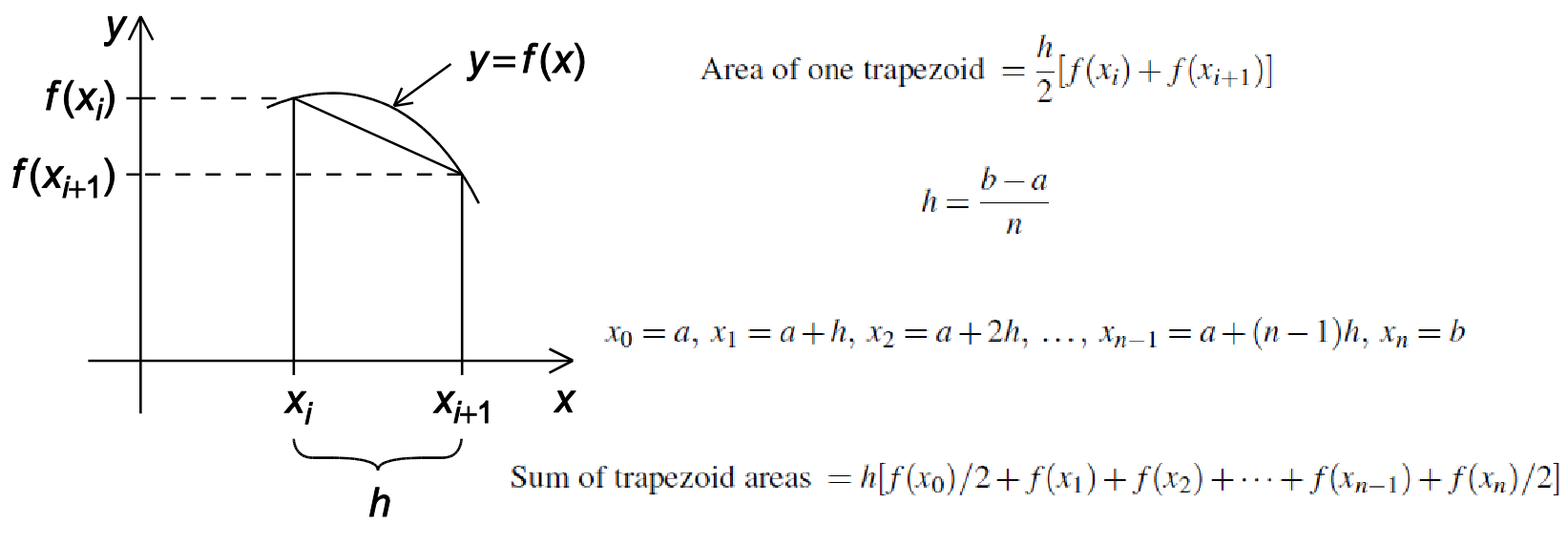
trapezoidal rule
Concept
We want to approximate the integral of a function by calculating the trapezoids inside it.