
limits
recently, it feels like a lot of loose threads have started to come together. things are beginning to form something larger, something that almost resembles a bigger picture. i could easily blame this on being at the end of my bachelor's degree - say that i've simply learned enough to start understanding what's going on -, but the truth is that most of it has happened over the past year, and most of it is a result of my choices.
from when i started considering vienna, things have been flowing and connecting almost too quickly.
i've been introduced to so so many new concepts, and i've found niches i want to bury myself in, corners i want to explore and futures i want to live.
so, from within the mess of hunger that is knowledge, here is one new thread i keep pulling at: i'm very interested in the "philosophy of language" side of logic !
wittgenstein's tractatus is one of my favourite books (it's kind of everywhere in this blog), but i realised i absolutely want to learn more about the other philosophers who shaped the history of semantics and the search for meaning.
to get closer to the topic (which isn't exactly part of my cs curriculum) and to make sure i was actually interested and i didn't just like the idea of it, i read "a very brief introduction to the philosophy of language", by paolo casalegno.
it's an introduction to an introduction — not particularly technical, nor especially deep - but it confirmed that i am, indeed, very interested!!
the interest isn't really new to me: i've always been drawn to "meta" things. the idea of "stepping outside" of our minds and looking at ourselves from an external perspective has fascinated me for as long as i can remember. it's one of the aspects i find most compelling about the tractatus - the claim that language cannot be used to describe itself.
how can we, so constrained by our means (by our minds) understand language when we're so deeply embedded in it?
how could a metalanguage exist without collapsing into just another language?
(it is, in a way, gödel's second incompleteness theorem: $T \not\vdash Consis(T)$, a system cannot prove its own consistency).
i think one of the views on this topos that has had the most impact on me was expressed by parmenides in his discussion of the "is not" (or, at least, what i took from it).
parmenides says:
"the other, namely, that it is not, and that it must needs not be — that, i tell thee, is a path that none can learn of at all. for thou canst not know what is not — that is impossible - nor utter it;"
he defines, in opposition to the "is" (which is essentially Truth), something that acts as a limit. he gets, in my opinion, terribly close to wittgenstein's:
"3.02 the thought contains the possibility of the state of affairs which it thinks. what is thinkable is also possible."
"4.1212 what can be shown cannot be said."
"5.6 the limits of my language mean the limits of my world."
and even
"5.632 the subject does not belong to the world but is a limit of the world."
thought and being, language and reality - all begin to collapse into one single thing. we cannot escape the bounds in which our thoughts operate; we cannot "not think" of something without, in some way, bringing it into existence. thinking and being become intertwined - if something can be thought, it must exist in some capacity. ("nothingness" remains fundamentally out of reach).
i don't necessarily want to fall into some form of solipsism (though i do think it true that we will never be able to have proof that other people exist just as we do, i'm not too interested in its consequences), but i'm just so fascinated by just how limited we are as beings. and, at the same time, how impossible it is to imagine what it would mean to be otherwise !
i've always been particularly weak to these thoughts - perhaps unsurprisingly, given the way my memory works (or rather sorta doesn't?) - i've always remembered things not as events or pictures, but as facts, as if told to me by someone; i have no recollection of myself in the past (nor a concept of the passage of time, really), and live reconstructing my feelings or actions from likelihood.
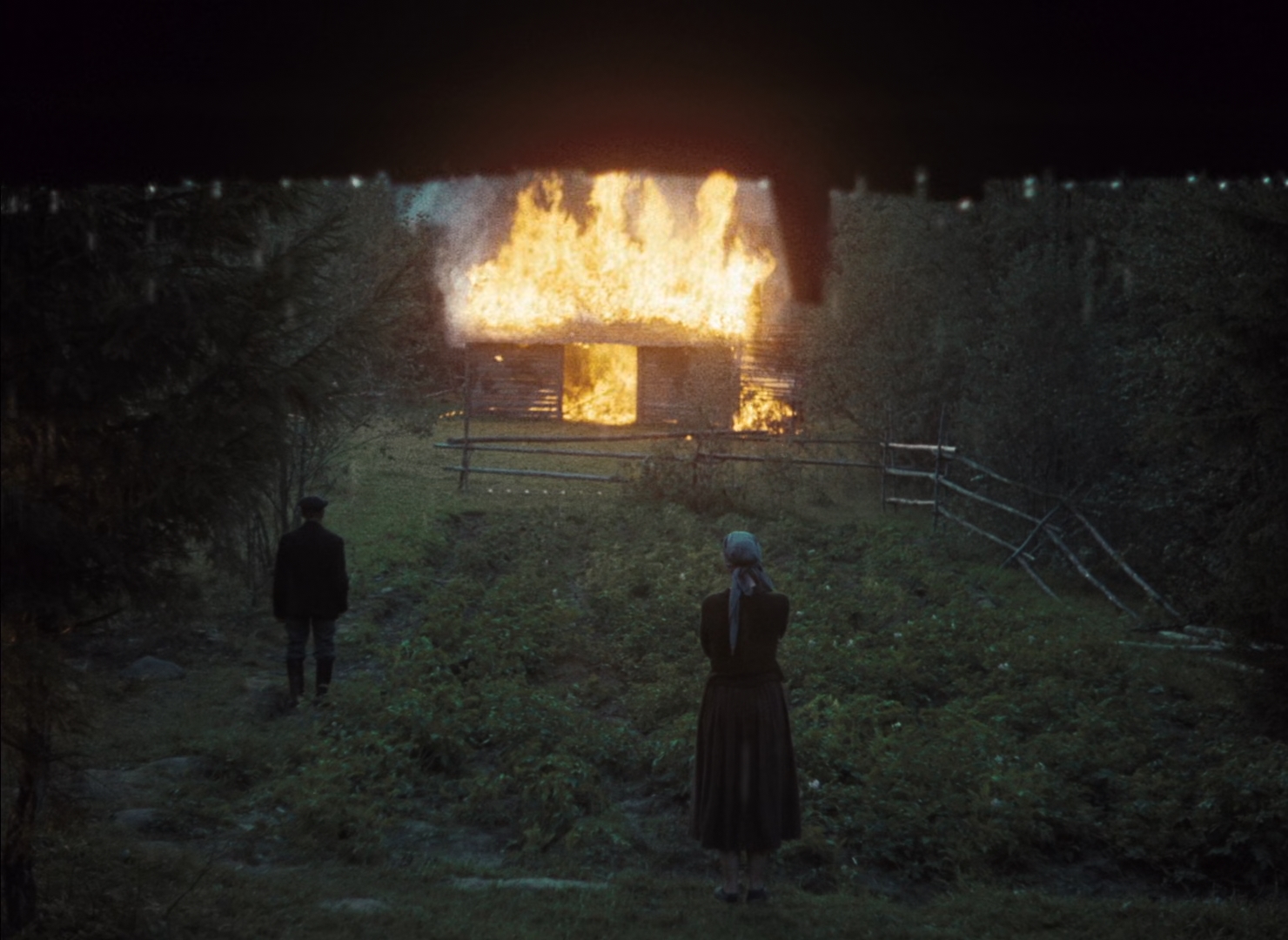
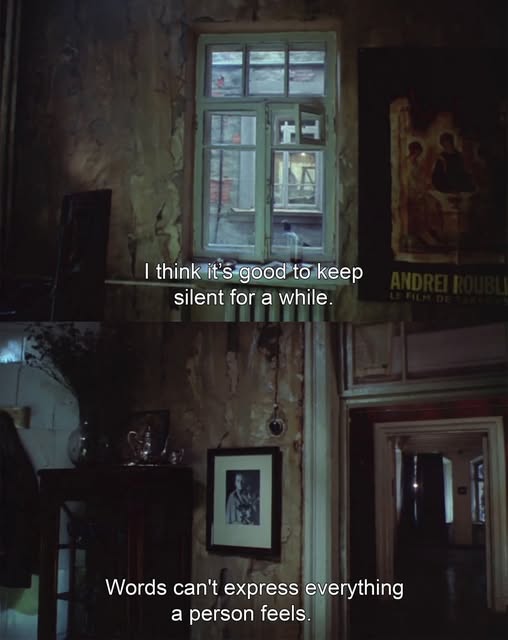
that's why tarkovsky's "mirror" affected me as much as it did. the way it treats memory feels somehow symmetrical to the way i experience mine — not as something actively lived, but reconstructed, closer to a story than to an event.
there is no stable "i" moving through time in the film, no clear boundary between past and present, self and other (even the characters in the protagonist's life blend together, his mother and wife being played by the same actress). everything sort of bleeds into everything else, as if the subject itself has dissolved and what remains is only fragments, impressions, images. (once again, he is not "part" of the world but rather its limit; we don't see adult aleksei directly, his self is is only inferred from what is given, he is effectively the film's world, a recollection of broken images).
i think mirror embodies proposition 4.1212 perfectly — having reached the point where language collapses into its own limits, the only thing left to do is to switch medium entirely.
and what cannot be said, tarkovsky lets exist anyway, in images, in time, in the strange continuity between thought and being.
the same collapse shows up in waiting for godot: language is constantly present and yet never quite reaches anything. the characters speak endlessly, but nothing is ever truly communicated. everything circles, repeats, dissolves before it can settle into meaning. words are, as sufjan steven puts it "futile devices" - they never quite bridge the gap.
and more and more my own language appears to me like a veil that must be torn apart in order to get at the things (or the Nothingness) behind it[samuel beckett]
it’s the same frantic reaching found in eliot's waste land — the "game of chess" where communication is just a series of desperate, unanswered questions: "speak to me. why do you never speak. speak. / what are you thinking of? what thinking? what? / i never know what you are thinking. think." the characters are in the same room, using the same language, but they are light years apart.
and thus we're drawn to forms of expression that move away from language altogether (or at least from intelligible language). we crave the ethereal. we bathe in the way artists like Cocteau Twins or Sigur Rós use voices - like an attempt to bypass meaning rather than construct it, to reach something that words would only distort. a lot is being said, but whatever that is cannot survive translation into language without sacrifying its essence. it remains there, as sound, as texture (as something closer to "showing" rather than saying).
this same impossibility lingers in quieter places, too — in lost in translation, in in the mood for love - films where nothing explicitly fails and yet everything does, where people circle around something they can almost say but never quite do. meaning exists somewhere just out of our reach, suspended between individuals but never fully shared (and we do grasp for it but always fail in capturing it.)
(it's the symbol grounding problem, or the chinese room argument — symbols, on their own, are empty, manipulation is not understanding, there is always a gap between structure and meaning that cannot be closed from within the system itself. and no matter how much we refine the system, add more rules, more words, more structure — something remains ungrounded, slightly out of reach, as if requiring a step outside that we can never actually take).
and that's the theme i keep returning to, for i somehow am that system - my memory gestures at experience without containing it. it only pretends to know what feeling truly is.
(but yet i feel. (but yet i live.))
and so this lack of meaning attracts me. it drives me. towards studies on language, towards logics, towards semantics. i absolutely want to know how we managed to create something as complicated as communication, how it works, the hidden common denominator in all its variants.
and i want to reconnect it to the things i know (to the things we made). to interpreters of patterns we maybe can't see yet.
so !! some of the things i want to get into are:
philosophy of language history
all of the basics of the field (slowly) - frege, russell, kripke (potentially particularly interesting as i'm curious about whether his kripke structures, that i know from formal methods, will appear), tarski and so many more !
sapir-whorf (banal, i know)
i know it's kind of like the "pop culture" of linguistics, but i obviously find the sapir-whorf hypothesis (and linguistic relativism (not determinism)) very fascinating. i can't help but think that, in a life so deeply filtered by language, it's impossible for it not to influence the way we think.
(to get into the basics, i watched the lea boroditsky TED talk and listened to the relative lingthusiasm podcast episode, but i obviously plan on reading the original texts soon).
(in the meantime, some cool "bar" facts i found out about:
- there's an aboriginal language - Kuuk Thaayorre - in which saying "hello" is asking "which direction are you headed?"
- some languages don't count ??
- i remembered how, in reading "the idiot" by elif batuman, i had been struck by the explanation of the turkish suffix "-mis":
I knew I thought differently in Turkish and English - not because thought and language were the same, but because different languages forced you to think about different things. Turkish, for example, had a suffix, -mis, that you put on verbs to report anything you didn't witness personally. You were always stating your degree of subjectivity. You were always thinking about it, every time you opened your mouth.
The suffix -mis had not exact English equivalent. It could be translated as "it seems" or "I heard" or "apparently." I associated it with Dilek, my cousin on my father's side - tiny, skinny, dark-complexioned Dilek, who was my age but so much smaller. "You complained-mis to your mother," Dilek would tell me in her quiet, precise voice. "The dog scared-mis you." "You told-mis your parents that if Aunt Hulya came to America, she could live in your garage." When you heard -mis, you knew that you had been invoked in your absence - not just you but your hypocrisy, cowardice, and lack of generosity. Every time I heard -mis, I felt caught out. I was scared of the dogs. I did complain to my mother, often. The -mis tense was one of the things I complained to my mother about. My mother thought it was funny.
probably actual linguistics
i think i would absolutely enjoy some linguistic theory !! especially since i want to see what the computer science field has to add to it (as will be mentioned in the next section)
connections
another theme of this period is connections. as i mentioned, recently, life has been surprising me with its way of making things pop up unexpectedly, and it has been making me think that maybe (just maybe) what i'm heading towards could make some sense.
the main place i've been finding links in is none other than my degree - not only because the recent courses i've taken me have allowed me to explore some concepts from different perspectives, but mainly beacause i've been exploring a lot of connected topics!!
monadic second-order logic and finite state machines and regular expressions (all have the same expressive power), the curry-howard correspondence (mathematical proofs are "equivalent" to programs ?? logical formulas are types??), fagin's theorem (second-order logic is equivalent to NP???) - the web that is computer science and logic is so well-woven it's amazing to watch.
these connections have led me to enormous rabbit holes, and, together with other stimuli (mainly my thesis), have been making my curiosity work overtime. i am terribly enjoying studying game-theoretic approaches to temporal logics and automata theory and actually constructing something (small but) new!!! going to meetings with my supervisor and being able to actually give my input actively and reason on things with him instead of just being taught (which i also obviously appreciate) is truly amazing, and it's been making me even more excited about the future !!!! it's a small glimpse into what i could do for a living - study and write things on whiteboards with other people and share ideas and debate and maybe even, one day, teach others ! it's all so so so thrilling.
i'm also considering going to ESSLLI 2026 - it's not exactly cheap, but the lectures sound so amazing? being able to dip a toe in the state of the art of exactly what interests me could be an amazing gift to myself (and knowing who is working on things could also be very useful for future plans).
i mean, just look at (some of) the courses they offer !!!!!!!! (they are very nerdy)
- Formal theories of vagueness (Marco Degano and Robert van Rooij)
- Introduction to the semantics and pragmatics of anaphora (Keny Chatain and Benjamin Spector) (crazy topic to hold a course on)
- Conditionals in Decision Theory (Calum McNamara and Paolo Santorio)
- The lambda calculus and simple type theory: A toolkit (Howard Gregory) (though i might have already covered this one)
- The Logic Underlying Language Models (Ryan Cotterell)
- Reasoning in graph games: A modal logic study (Sujata Ghosh and Dazhu Li) (!!!!!!)
- Modeling Awareness (Gaia Belardinelli and Snow Zhang)
- Algebraic Automata Theory: A Rosetta Stone for Computer Scientists (Nicola Gigante)
- Combinatorial Games in Finite Model Theory (Phokion Kolaitis)
- Proofs without syntax: An introduction to proof nets and combinatorial proofs (Willem Heijltjes and Lutz Straßburger)
- A Gentle Introduction to Description Logics (Ivan Varzinczak)
- Stone Duality: Connecting Algebra and Topology via Logic (Levin Hornischer) (!!!!!)
- Computational perspectives on the classical decision problem: a vade mecum (Bartosz Bednarczyk and Ian Pratt-Hartmann)
- Introduction to Homotopy Type Theory / Univalent Foundations (Tom de Jong) (!!!!!! i absolutely want to become one of the crazy people that study HoTT)
- Coordination games, rationality, and logic (Valentin Goranko)
all of these topics sound so fascinating and i want to know everything about each one of them and fill my head with knowledge until it explodes.
elucidations podcast !!
one extremely cool resource that i've found while digging my holes is the 'elucidations' podcast by Matt Teichman, a lecturer at the University of Chicago. he interviews professors and experts on concepts related to philosophy, computer science, logics and their intersections, and the topics are so specific !! and they fit exactly in my areas of interest !! so far, i have only listened to episodes '53: Martin Stokhof discusses formal semantics and Wittgenstein' (very good!) (also, martin stokhof is a professor at UvA's Institute for Logic, Language and Computation, which i am VERY interested in (a potentially cool place i could do my PhD in)), '111: Greg Kobele discusses mathematical linguistics' and '153: Sam Enright discusses lifelong learning', but i have a huge queue i will (slowly, so i can enjoy them) get through.
(highlights are: '132: Rebecca Valentine discusses queer hackerspaces', '105: R.A. Briggs discusses epistemic decision theory', '89: John Collins discusses language universals', '81: Cathy Legg discusses what Peirce's categories can do for you', '36: Robert van Rooij discusses vagueness', '18: Mark Lance discusses language and power', '47: Alexandru Baltag discusses the logic of knowledge')
repetition
throughout all of this, i've been accompanied — almost continuously — by a specific type of music. not necessarily "electronic" in a strict sense, but music that loops, that lingers, that unfolds and surrounds you. fred again, slowdive remixes, the smile's "teleharmonic", beach house, oklou, aphex twin, "non è reale" by andrea laszlo de simone — they all seem to operate in that same space just at the edge of articulation. there is something about repetition, about the slight variations within it, that's almost like being held in place while everything else dissolves. like being completely submerged. like standing in the street while the winter sun washes over you, becoming part of something larger. like giving up the search for meaning, for a coherent story in a song and getting captured by the music, fading into it, becoming one with it. letting go of all of the tension and jumping up and down in your house at 10pm (sorry to the neighbours), walking aimlessly around and around and around the block in a much-needed break from studying.
the music i've been listening to has samples and voices and sounds, and it is music that envelops you
some specific song recs include:
- lights burn dimmer by fred again (the peak of therapeutic repetition)
- hard2sleep + driving fast (very upbeat, english accent rap over dance music) and shine a light (more nostalgic) by swimming paul (he is very very very reminiscent of fred again (maybe too much?), but they're very good listens)
- 'non è reale - malik djoudi remix' by andrea laszlo de simone - a really unique remix ? french dreamy sounds over yet another 'repetitive' song
- the order of death by public image ltd - stolen from marty supreme's soundtrack
- all of the kisses remixes - each one is special in its own way (and kisses is an amazing song to begin with)
- i'm new here by Jamie xx - music mixed on Gil Scott-Heron voice tracks, very cool project
- vegyn songs !! i really really really like Headache's albums, i think his reworks of Air are very good, and i also really enjoy 'the road to hell is paved with good intentions' (especially 'turn me inside' and 'the path less traveled' !)
also, i obviously made a playlist that i listen to while working on my thesis - it has the same vibe as the others, but is a bit more upbeat, and it makes me want to dance around (nina simone remixes are majestic !!!!!!!) (also, my supervisor plays jazz piano, so she's on theme)